
Copper to steel
The metal order is copper (30 ingots), iron (100), steel (40 plates) and gold (50). Steel plates are the rarest achievement in the game at 1.0% of players.
Four metal achievements and one number that changed before launch: the forge used to cost five iron ingots and now costs three.
Every figure below is checked against Pequi studios announcements or Steam's own endpoints on 2026-11-09.
Metal is the game's real progression spine. There are no levels, no skill points and no classes; there is a ladder of alloys, and every tool, weapon and station sits somewhere on it.
Copper, iron, gold, steel
| Metal | Achievement | Requirement | Global unlock |
|---|---|---|---|
| Copper | Copper Age | Craft 30 copper ingots | 5.7% |
| Iron | Iron Age | Craft 100 iron ingots | 19.3% |
| Gold | Golden Age | Craft 50 gold ingots | 6.5% |
| Steel | Master of Steel | Craft 40 steel plates | 1.0% |
The rates are not in ladder order, and that is the most useful thing on this page. Iron is the most-crafted metal by a wide margin at 19.3%, four times copper's rate. The explanation is that iron is the working metal of the mid-game: you craft a hundred ingots because you are building tools, stations and structures out of it, not because you are completing a collection. Copper is a smaller rung that most players pass through quickly, so fewer of them ever hit the thirty-ingot count.
Steel at 1.0% is the rarest achievement in the entire game, out of fifty-four. Forty steel plates is not a hard fight, it is a long grind, and it is where the achievement list effectively ends.
Five iron became three
Before 24 October, building the forge cost five iron ingots. It now costs three. The patch note is explicit about why: iron was harder to get in the early game than the developer intended.
That change is small in isolation and significant in sequence. Three iron ingots is reachable from a modest mining run; five is a project. A guide written during the demo period has the early metal game out of date by forty percent.
Eight stations
| Station | What it does | Where it sits in progression |
|---|---|---|
| Workbench | Basic tools and structures | First station |
| Furnace | Smelts ore into ingots | Before the forge |
| Forge | Metal tools and weapons | Three iron ingots to build |
| Sewing table | Backpacks and cloth | Moved before the drying frame on 24 Oct |
| Cooking pot | Meals rather than raw food | Early, but its value grows all game |
| Stove | Cooking, with a fuel system | Mid-game kitchen |
| Drying frame | Preserved goods | After the sewing table |
| Alchemist's machine | Potions | Late; moved into a cave on 9 Nov |
Two of those rows changed in the first week and both are worth knowing.
The sewing table moved earlier. The 24 October patch put it in front of the drying frame specifically because the backpack gates inventory capacity, and inventory capacity gates everything. A guide that builds a drying frame first predates that change.
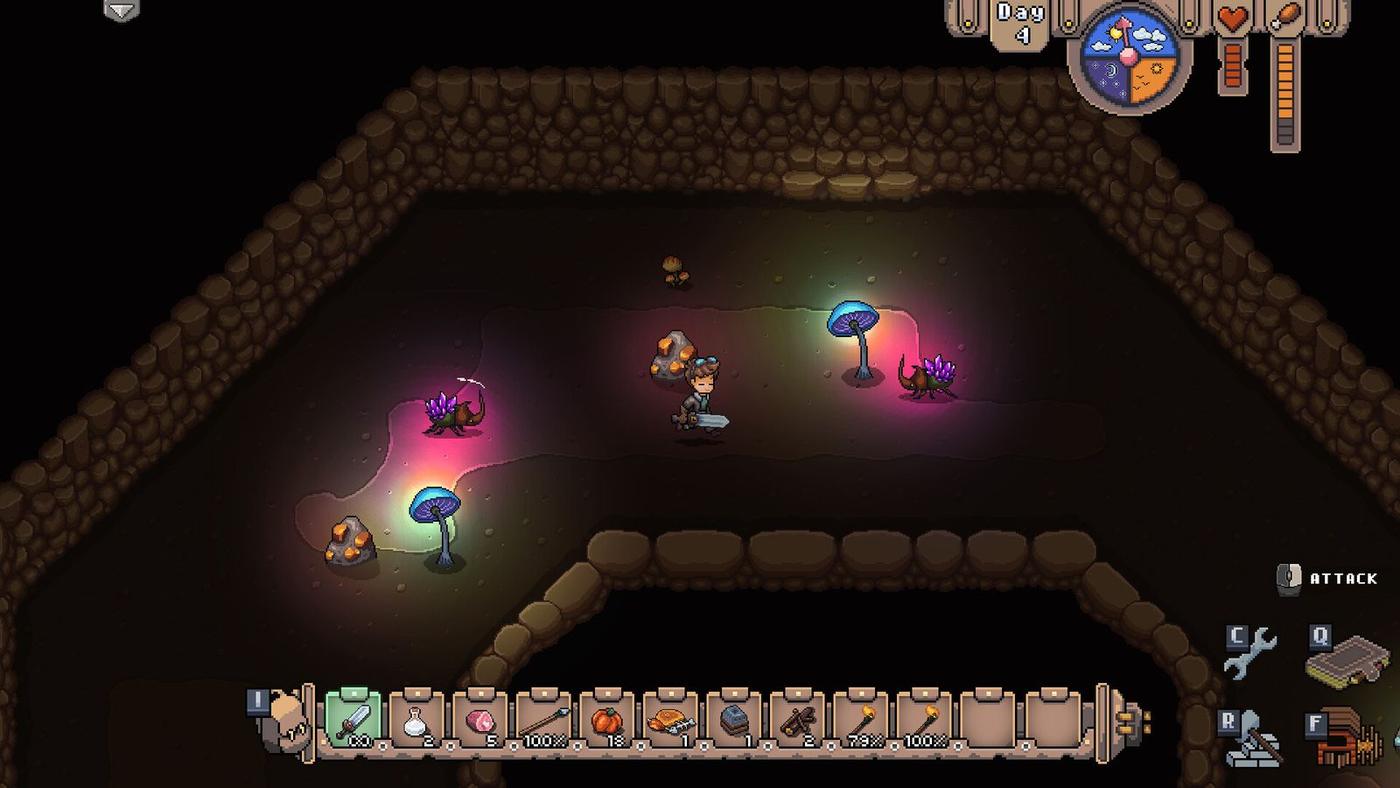
The alchemist's machine moved into a cave. The 9 November patch fixed a bug where the machine could disappear, and states that it can now be found inside the cave. Not a cosmetic fix: players who built one and watched it vanish lost the station entirely. Missing on an older build? The bug you are looking at, exactly.
Tools follow the metal
Tools follow the metal. Stone tools open wood and basic mining; copper opens the first metal tools; iron carries the mid-game; steel sits at the end. The achievement list confirms the tools that exist: axe, pickaxe, spear, boomerang, hammer, sickle, fishing rod and the protagonist's sword.
Two tool facts from the patch notes are worth carrying into a playthrough. The sickle's durability consumption was reduced by 25% on 7 November, which makes it a much better tool than it was at launch. And on 6 November, weapons unsuitable for fighting a particular boss stopped breaking during the fight — they now simply deal no damage. That second change matters for your loadout: you no longer need to guess which weapon a boss is weak to before you engage, because bringing the wrong one costs you damage rather than the weapon itself.
Copper: thirty ingots
Thirty copper ingots is achievable from surface deposits and a furnace. The point where stone tools stop and metal ones start, and at 5.7% the achievement marking the shift from surviving to progressing.
Short on copper usually means short on fuel, not ore. Smelting needs a furnace running, and furnaces need fuel. Manure is one answer, which is what the Biofuel achievement at 6.4% is about.
Iron: a hundred, by accident
A hundred iron ingots at 19.3% is the most-completed metal achievement, which sounds contradictory until you look at what iron is for. The material of the mid-game: stations, tools, structural pieces, and the forge itself costs iron to build.
The practical consequence is that you will pass a hundred iron ingots without trying if you build out a base. The achievement is a side effect of playing normally, and it is the only metal achievement most players will ever get.
Gold and steel: the tail
Fifty gold ingots (6.5%) and forty steel plates (1.0%) are the two that require deliberate effort. Steel in particular is the rarest thing in the game's achievement list, rarer than finishing the story at 2.6% and rarer than visiting all twenty-four islands at 4.0%.
That ordering is worth sitting with. More players have completed the main story than have crafted forty steel plates. Steel is not on the critical path; it is an optional grind at the end of the metal tree, and the data says almost nobody bothers.
No ore ratios, no durability
Ingot counts are published because achievements require them. Ore-per-node, smelting ratios and tool durability values are not published anywhere, and no page here will invent them. The forge cost of three iron ingots is known because the developer changed it in a patch note; the cost of everything else is not, and the honest answer is that you find out by opening the crafting menu.